Table of Contents
- Quick Answer
- Quick Checklist: Samsung Refrigerator Not Making Ice
- 1. Ice Maker Is Turned Off or in Test Mode
- 2. Water Supply Line Is Kinked, Frozen, or Clogged
- 3. Water Filter Needs Replacing
- 4. Frozen Ice Maker Assembly or Ice Blockage
- 5. Defrost System Failure
- 6. Low Water Pressure
- 7. Faulty Water Inlet Valve
- 8. Ice Maker Sensor or Control Board Failure
- 9. Samsung Refrigerator Not Making Ice But Water Works
- Samsung Ice Maker Reset: Step-by-Step Instructions
- Samsung Refrigerator Ice Maker Error Codes to Watch For
- When to Call a Professional
- Frequently Asked Questions
- How do I reset my Samsung refrigerator ice maker?
- Why is my Samsung fridge not making ice but the water works?
- How long does it take for a Samsung ice maker to make ice after a reset?
- What is the most common reason a Samsung refrigerator stops making ice?
- Is it worth repairing a Samsung ice maker or should I replace it?
- How do I force my Samsung ice maker to make ice?
- Conclusion
Quick Answer
If your Samsung refrigerator is not making ice, first make sure the ice maker is turned on, the freezer is set to 0°F, the ice bin is not jammed, and the water filter is not overdue for replacement. Check that the water supply line is not kinked and that the dispenser has normal flow. Reset the ice maker if needed, then allow 6 to 24 hours for new ice. If it still does not produce ice, a frozen assembly, inlet valve, sensor, or defrost problem may need service.
If your Samsung refrigerator is not making ice, this guide helps you identify the most likely cause and the right next step. You will learn how to check the ice maker settings, freezer temperature, ice blockage, water filter, supply line, and water pressure before moving on to components such as the inlet valve, sensors, and defrost system. Start with the simple checks below, then allow up to 24 hours for ice production to resume after a reset or repair.
A Samsung refrigerator not making ice is one of the most common complaints we hear at 911 Appliance Repair. Samsung builds feature-rich refrigerators with French door, bottom freezer, and side-by-side configurations, but their ice makers have specific failure points that differ from LG, Whirlpool, and GE. When your Samsung fridge not making ice becomes a daily frustration, the good news is that many fixes are DIY-friendly and cost nothing. This guide walks through the nine most common causes in the order you should check them, starting with the simplest resets and moving toward parts that require a technician. If you are in the San Diego area and want to skip the troubleshooting, call us at 800-929-1192 for same-day service.

TL;DR: A Samsung refrigerator not making ice most commonly has a turned-off ice maker, a frozen water line, a clogged water filter, or a faulty water inlet valve. Start with a reset and a filter check before replacing parts. If the ice maker still will not produce ice after 24 hours, call 911 Appliance Repair at 800-929-1192 for same-day Samsung ice maker repair in San Diego.
Quick Checklist: Samsung Refrigerator Not Making Ice
Before diving into individual causes, run through this 60-second checklist. It catches the most common and easiest-to-fix problems:
- Is the ice maker turned on? Check the control panel or the ice maker on/off switch on the unit itself.
- Is the ice bin full or jammed? An overfull bin or clumped ice can stop production. Empty it and check for stuck cubes.
- Is the water filter old? Samsung recommends replacing it every 6 months. A clogged filter restricts water flow to the ice maker.
- Is the water supply line kinked or pinched? Pull the fridge out and inspect the line behind it.
- Is the freezer cold enough? The ice maker needs the freezer at 0 degrees Fahrenheit. If the freezer is warm, the ice maker will not cycle.
- Has there been a recent power outage? The ice maker may need a manual reset after power is restored.
If none of these solve the problem, work through the nine causes below.
1. Ice Maker Is Turned Off or in Test Mode
The single most common reason a Samsung ice maker not working is that it has been turned off, either accidentally or by a child pressing buttons on the control panel. Samsung ice makers can also get stuck in test mode, where they run a diagnostic cycle but never resume normal ice production.
How to tell: Open the freezer and look at the ice maker assembly. If the on/off switch (a small lever or button on the side of the unit) is in the off position, the ice maker will not run. On models with a control panel, check for an ice maker icon that is dimmed or crossed out. If the ice maker is in test mode, you may hear it cycling continuously without producing any ice.
How to fix it: Flip the on/off switch to the on position. If the ice maker is stuck in test mode, press and hold the test button (usually located on the front or side of the ice maker assembly) for 3 to 5 seconds until you hear a chime. The ice maker should exit test mode and begin a normal cycle. Wait 6 to 24 hours for the first batch of ice after reactivating the unit.
2. Water Supply Line Is Kinked, Frozen, or Clogged
The water supply line delivers water from your home plumbing to the refrigerator, where it feeds both the water dispenser and the ice maker. If this line is kinked, frozen, or clogged with sediment, the ice maker will not receive enough water to produce ice.
How to tell: Check behind the refrigerator where the supply line connects. Look for sharp bends, crimps, or pinches in the tubing. If the line is frozen, you may notice that the water dispenser also works slowly or not at all. A clogged line is harder to diagnose visually but is common in homes with hard water or old plumbing.
How to fix it: Straighten any kinks in the supply line. If the line is frozen, unplug the refrigerator and use a hair dryer on low heat to warm the line gently, or leave the fridge unplugged for 2 to 3 hours to let it thaw. If the line is clogged with sediment, it may need to be replaced. A new supply line costs $10 to $20 at any hardware store and takes 10 minutes to swap. For more on related water flow issues, see our guide on a Samsung refrigerator not making ice but water works below.
3. Water Filter Needs Replacing
Samsung refrigerators use an internal water filter that removes contaminants from the water feeding both the dispenser and the ice maker. Over time, the filter becomes clogged with sediment, minerals, and debris. When that happens, water flow to the ice maker drops below the level needed to fill the ice mold, and production slows or stops entirely.
How to tell: If you cannot remember the last time you replaced the water filter, it is probably overdue. Samsung recommends replacement every 6 months or every 300 gallons, whichever comes first. Other signs of a clogged filter include slow water dispensing, cloudy or bad-tasting ice, and a filter indicator light on the control panel.
How to fix it: Replace the water filter with a Samsung-compatible replacement. The filter is usually located in the upper right corner of the refrigerator compartment or in the base grille at the bottom. Twist the old filter counterclockwise to remove it, then twist the new one in clockwise until it locks. Run 3 to 5 gallons of water through the dispenser to flush air and carbon dust from the new filter before checking the ice maker. For ongoing care tips, see our Samsung refrigerator maintenance guide.
4. Frozen Ice Maker Assembly or Ice Blockage
Samsung ice makers are located inside the freezer, where temperatures are below freezing. If the ice maker assembly itself freezes up, or if ice clumps together and blocks the ejector arm, the unit cannot harvest ice even though it may still be filling the mold with water.
How to tell: Open the freezer and remove the ice bin. Look at the ice maker assembly for visible ice buildup on the mold, the ejector arm, or the sensor area. If the ejector arm is frozen in place or there is a solid block of ice in the mold, the assembly is frozen. You may also notice that the ice maker makes a humming sound as the motor tries to push the stuck ice but cannot.
How to fix it: Remove the ice bin and any loose ice. If the mold is frozen, use a plastic utensil (never metal, which can damage the coating) to gently break up the ice. For a deeper freeze, unplug the refrigerator and place a towel in the freezer to catch melting water, then leave the freezer door open for 1 to 2 hours to let the assembly thaw. If the ice maker freezes up repeatedly, the problem is likely a faulty water inlet valve that is overfilling the mold, or a defrost system issue causing excess frost. Our freezer not freezing troubleshooting guide covers defrost problems in detail.

5. Defrost System Failure
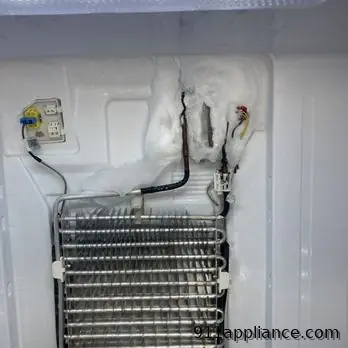
Samsung refrigerators use an automatic defrost cycle that melts frost off the evaporator coils every 8 to 12 hours. If the defrost system fails, frost builds up on the coils until airflow is blocked. The freezer temperature rises, and the ice maker stops producing ice because it needs the freezer at 0 degrees Fahrenheit to cycle properly.
How to tell: Look at the back interior wall of the freezer. If you see a thick layer of frost or ice building up, the defrost system is not working. The ice maker may have stopped producing ice at the same time the freezer started feeling warmer than usual. You may also notice that the refrigerator compartment is warming up.
How to fix it: A manual defrost (unplugging the refrigerator for 24 hours with the doors open) will temporarily restore cooling and ice production by melting the ice. But if the defrost system is not repaired, the frost will return within 1 to 2 weeks and the ice maker will stop again. The failed component is usually the defrost heater, the defrost thermostat (bimetal), or the main control board. Testing these requires a multimeter and is best left to a professional. For a deeper dive, see our Samsung refrigerator not cooling troubleshooting guide, which covers defrost system failures in detail.
6. Low Water Pressure
Samsung ice makers require a minimum water pressure of 20 to 30 psi to fill the ice mold properly. If your home water pressure is too low, the ice maker will not receive enough water during the fill cycle, and production will slow or stop. Low water pressure can be caused by a partially closed supply valve, a clogged supply line, old plumbing with mineral buildup, or a whole-house pressure issue.
How to tell: Check the water dispenser. If water comes out slowly or in a thin stream, your pressure may be too low. You can also disconnect the supply line at the back of the refrigerator and briefly turn on the water valve into a bucket to see if the flow is strong and steady. A plumber or appliance technician can test the exact pressure with a gauge.
How to fix it: Fully open the supply valve behind the refrigerator. If the valve is already fully open and the flow is still weak, check for kinks in the line and replace the line if it is old or clogged. If the problem is whole-house low water pressure, you may need a plumber to install or adjust a pressure regulator. Samsung refrigerators are sensitive to low pressure, and even a small drop can stop ice production.
7. Faulty Water Inlet Valve
The water inlet valve is an electrically controlled valve at the back of the refrigerator that opens to let water flow into the ice maker and the water dispenser. If the valve fails, either it will not open at all (no water reaches the ice maker) or it will not close fully (water continuously drips into the ice maker, causing overflow and freezing). Both scenarios stop normal ice production.
How to tell: If the water dispenser works but the ice maker does not, the valve may have failed on the ice maker side only. If neither the dispenser nor the ice maker gets water, the entire valve may be bad. You can test the valve with a multimeter for continuity. No continuity means the solenoid coil is burned out and the valve needs replacement. A valve that hums but does not let water through may be mechanically stuck.
How to fix it: The water inlet valve is located at the bottom back of the refrigerator, where the supply line connects. Unplug the refrigerator, shut off the water supply, and disconnect the line. Remove the valve (usually held by a bracket and screws), disconnect the electrical connectors and internal water tubes, and install the new valve. The part costs $30 to $60. If you are not comfortable working with electrical components, this is a quick and inexpensive repair for a technician. See our ice maker repair cost guide for pricing details.
8. Ice Maker Sensor or Control Board Failure
Modern Samsung ice makers rely on sensors and control boards to manage the ice-making cycle. A temperature sensor tells the ice maker when the mold is cold enough to freeze water. A level sensor or feeler arm detects when the ice bin is full. The main control board coordinates the timing of the fill, freeze, and harvest cycles. If any of these components fail, the ice maker may stop working entirely or produce ice erratically.
How to tell: This is one of the harder causes to diagnose because the symptoms mimic other failures. The ice maker may fill with water but never harvest the ice, or it may harvest ice but never refill. The control panel may display an error code. Common Samsung ice maker error codes include 14E (ice maker sensor fault), 15E (ice maker function error), and 40E (refrigerator sensor fault).
How to fix it: Diagnosing a sensor or control board failure requires testing live electrical components with a multimeter and comparing readings to Samsung service manual specifications. The ice maker sensor is usually integrated into the ice maker assembly on Samsung models, so the entire assembly may need replacement rather than just the sensor. Control board replacement must be matched to your exact model number. This is a job for a professional technician who can accurately diagnose which component has failed and order the correct replacement part.
9. Samsung Refrigerator Not Making Ice But Water Works
One of the most searched Samsung ice maker problems is the specific scenario where the water dispenser works fine but the ice maker produces no ice. This is a common and frustrating issue because it tells you the water supply, filter, and inlet pressure are all adequate. The problem is isolated to the ice maker circuit.
How to tell: If the water dispenser dispenses water at normal speed and volume, but the ice maker has not produced ice in 24 hours or more, you have this specific issue. Check whether the ice maker is turned on, whether the mold has water in it, and whether the ejector arm moves when you press the test button.
How to fix it: The most common causes when water works but ice does not are a frozen water line between the valve and the ice maker, a failed water inlet valve on the ice maker side only, a frozen ice maker assembly, or a failed ice maker module. Start by running the ice maker test mode (press and hold the test button for 3 to 5 seconds). If the test cycle runs but no water enters the mold, the problem is the supply line to the ice maker or the ice maker side of the inlet valve. If water enters the mold during the test but the ice maker does not harvest, the module or sensor is likely bad. In either case, a technician can pinpoint the failure quickly. Our Samsung appliance repair page has more information on the models we service.
Samsung Ice Maker Reset: Step-by-Step Instructions
Resetting the ice maker is the first troubleshooting step and resolves a surprising number of cases. Here is the step-by-step process for the most common Samsung ice maker types.
Step 1: Locate the ice maker in the freezer compartment. On Samsung French door refrigerators, it is usually in the upper left corner of the freezer. On bottom freezer models, it may be on the top shelf.
Step 2: Find the test button. On most Samsung ice makers, it is a small button on the front or bottom of the ice maker assembly, sometimes labeled “Test” or marked with an icon.
Step 3: Press and hold the test button for 3 to 5 seconds until you hear a chime. The ice maker will begin a test cycle that lasts about 6 minutes. During this cycle, it will fill the mold with water, wait for it to freeze, and then attempt to harvest the ice.
Step 4: If the test cycle fills the mold with water, the water supply is working. Wait 6 to 24 hours for the ice to freeze and harvest. If the test cycle does not fill the mold, the problem is in the water supply, inlet valve, or supply line.
Step 5: For a full power reset, unplug the refrigerator for 5 minutes, then plug it back in. This resets the main control board and can clear electronic glitches that prevent the ice maker from cycling.
After a reset, the ice maker needs 6 to 24 hours to produce the first batch of ice. Do not expect immediate results.
Samsung Refrigerator Ice Maker Error Codes to Watch For
If your Samsung refrigerator has a display panel, it may show an error code that points directly to the ice maker problem. Here are the most common codes:
| Code | Meaning | Likely Cause |
|---|---|---|
| 14E | Ice maker sensor fault | Bad sensor or wiring |
| 15E | Ice maker function error | Ice maker module failure |
| 40E | Refrigerator sensor fault | Bad sensor or wiring |
| 22E | Freezer sensor fault | Bad sensor or wiring |
| 25E | Defrost sensor fault | Defrost thermostat or heater failure |
| 88 | Power interruption or control board error | Control board or power supply |
If you see any of these codes, note it before calling for service. It helps the technician bring the right part on the first visit.
When to Call a Professional
Some of these fixes are simple enough to do yourself: turning the ice maker on, replacing the water filter, straightening a kinked supply line, and running a reset. But anything that involves the water inlet valve, the ice maker module, the control board, or the defrost system is best left to a professional. Attempting these repairs without the right tools and training can cause further damage and void any remaining warranty coverage.
At 911 Appliance Repair, we have been repairing Samsung refrigerators in San Diego for over 30 years. We are a family-owned business since 1991 with an A+ BBB rating and 557 reviews at 4.8 stars. Our technicians carry common Samsung replacement parts on their service vehicles, including water inlet valves, ice maker assemblies, defrost heaters, and control boards, so most repairs are completed in a single visit. Our house call is $49.95, which is waived if you proceed with the repair, and all work is backed by a 1-year warranty on parts and labor.
Call 800-929-1192 to schedule same-day service, or visit our Book Online page to choose an appointment time. For more information about the Samsung models we service, see our Samsung appliance repair page. You can also browse our full range of services, check our service area to confirm we cover your neighborhood, read our reviews, learn about our warranties, or visit our blog for more troubleshooting guides.
Frequently Asked Questions
How do I reset my Samsung refrigerator ice maker?
Press and hold the test button on the ice maker assembly for 3 to 5 seconds until you hear a chime. The ice maker will run a 6-minute test cycle. If that does not work, unplug the refrigerator for 5 minutes and plug it back in to reset the control board. After either reset, wait 6 to 24 hours for the first batch of ice.
Why is my Samsung fridge not making ice but the water works?
When the water dispenser works but the ice maker does not, the water supply and filter are fine. The problem is isolated to the ice maker circuit. The most common causes are a frozen water line between the valve and the ice maker, a failed water inlet valve on the ice maker side, a frozen ice maker assembly, or a bad ice maker module. Run the test cycle to narrow it down.
How long does it take for a Samsung ice maker to make ice after a reset?
After a reset, a Samsung ice maker typically takes 6 to 24 hours to produce the first batch of ice. The ice maker needs to fill the mold, freeze the water, and harvest the cubes. The exact time depends on freezer temperature, how often the door is opened, and whether the unit was fully thawed before the reset.
What is the most common reason a Samsung refrigerator stops making ice?
The most common reason is that the ice maker has been turned off accidentally or is stuck in test mode. After that, the most frequent mechanical causes are a clogged water filter, a frozen water supply line, and a faulty water inlet valve. Replacing the water filter and running a reset resolves a large percentage of cases.
Is it worth repairing a Samsung ice maker or should I replace it?
In most cases, repairing is worth it. The most common fixes (water filter, supply line, inlet valve) cost $50 to $200 with labor. A full ice maker assembly replacement runs $200 to $400. A new Samsung refrigerator costs $1,500 to $4,000. If your refrigerator is under 10 years old and the repair costs less than half the value of the fridge, repair is the better choice. See our ice maker repair cost guide for a full breakdown.
How do I force my Samsung ice maker to make ice?
Press and hold the test button on the ice maker for 3 to 5 seconds. This forces a manual cycle that fills the mold with water, freezes it, and harvests the ice. If the test cycle fills the mold with water, the ice maker is functional and just needed a reset. If no water enters the mold during the test, the problem is in the water supply, inlet valve, or supply line, and the ice maker cannot be forced to produce ice until that is fixed.
Conclusion
Start with the basics: confirm the ice maker is on, set the freezer to 0°F, clear any ice blockage, and check the filter and water supply. After a reset or correction, allow 6 to 24 hours for ice production to return. If the freezer is warm, water flow is weak, or the ice maker repeatedly freezes up, the issue may involve the defrost system, inlet valve, sensor, or control board. At that point, schedule professional diagnosis to prevent further refrigerator problems.