Table of Contents
- Quick Answer
- Quick Checklist: GE Washer Not Spinning
- 1. Unbalanced Load
- 2. Broken Lid Switch (Top-Load Models)
- 3. Worn or Broken Drive Belt
- 4. Faulty Door Lock Assembly (Front-Load Models)
- 5. Clogged Drain Pump or Filter
- 6. Motor Reset Needed (Hydrowave Models)
- 7. Drive Motor or Inverter Board Failure
- 8. Control Board or Timer Failure
- GE Washer Error Code Reference
- How to Reset a GE Washer
- When to Call a Professional
- Frequently Asked Questions
- Why is my GE washer not doing spin cycle?
- How do you reset a GE washer that won’t spin?
- How do you reset the spin cycle on a GE washing machine?
- How do I fix a washer that won’t spin cycle?
- Conclusion
Quick Answer
A GE washer that will not spin is usually dealing with an unbalanced load, an open or failed lid/door lock, standing water caused by a drain blockage, or a drive-system problem. First, redistribute the load, confirm the washer is level, check the drain hose for kinks, and run a rinse-and-spin cycle without detergent. If water remains in the tub, clean the accessible drain filter if your model has one. If the washer still will not spin, a lid lock, belt, motor, or control issue may require service.
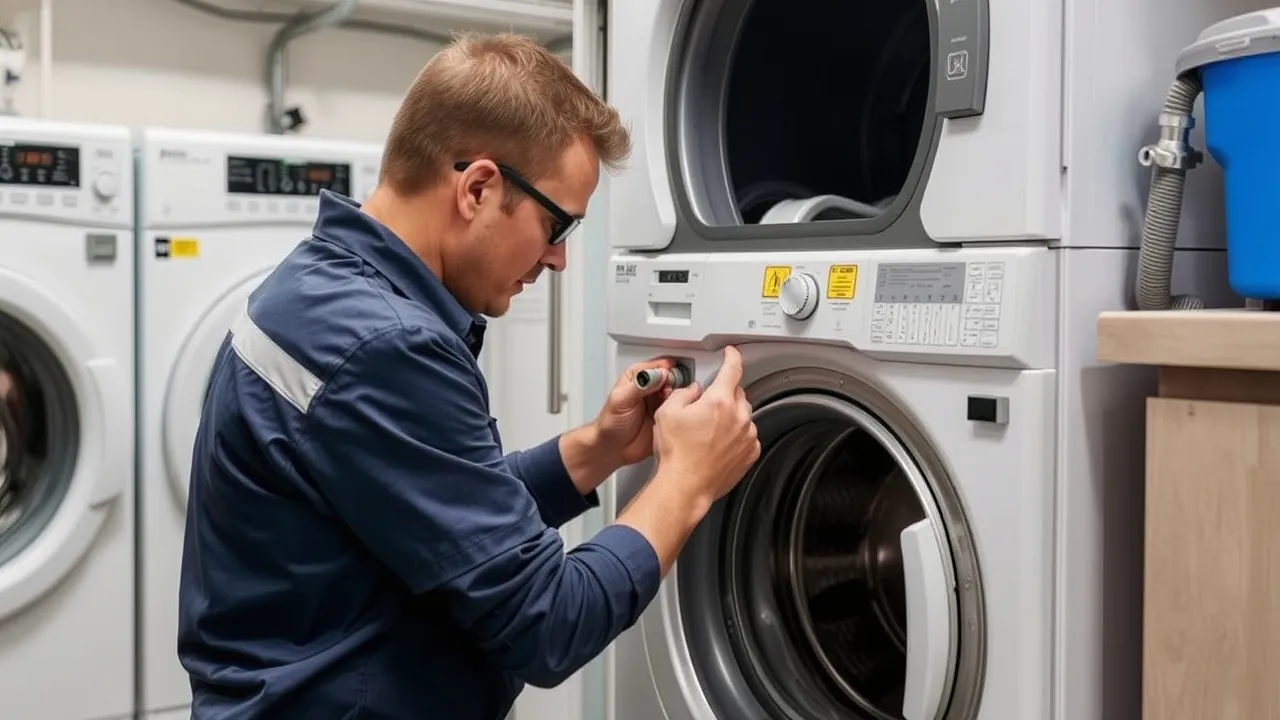
A GE washer that fills and agitates but will not spin is one of the most common service calls we get at 911 Appliance Repair. GE washers have specific failure points that differ from Whirlpool, LG, and Samsung machines. GE uses a Hydrowave drive system on many top-load models and a different motor control architecture on front-load models, and these designs have their own common spin failures. When your GE washer leaves clothes soaking wet at the end of the cycle, the cause is usually one of eight specific components.
This guide walks through each one in the order you should check them, starting with the simplest fixes you can do yourself and moving toward the parts that require a technician. If you are in the San Diego area and would rather not troubleshoot, call us at 800-929-1192 for same-day GE appliance repair.
Quick Checklist: GE Washer Not Spinning
Before diving into individual causes, run through this 60-second checklist. It catches the most common and easiest-to-fix problems:
- Is the load unbalanced? A single heavy item like a soaked blanket can trigger the unbalanced load sensor and stop the spin cycle.
- Is the lid fully closed? GE top-load washers will not spin if the lid switch does not detect a closed lid.
- Is there standing water in the drum? The washer will not spin if water remains. Check the drain hose for kinks.
- Are you using too much detergent? High-efficiency detergent in a GE washer can create excessive suds that prevent spinning. Run a rinse and spin cycle with no detergent.
- Is the washer level? An unlevel machine can refuse to spin. Check that all four feet are firmly on the floor.
If none of these solve the problem, work through the eight causes below.
1. Unbalanced Load
This is the single most common reason a GE washer does not spin, and it is not a malfunction. GE washers have an unbalanced load detection system that prevents the drum from spinning at high speed if the load is distributed unevenly. This protects the drum bearings and prevents the machine from walking across the floor.
The system works by measuring the weight distribution as the drum rotates slowly. If it detects a heavy concentration on one side, it stops and attempts to redistribute the load by rotating back and forth. If it cannot balance the load after several attempts, it skips the spin cycle and ends with the clothes still soaking wet.
How to tell: The washer fills, washes, and drains normally, but the drum never reaches spin speed. The clothes are soaking wet when you open the lid or door.
How to fix it: Open the lid or door, redistribute the clothes evenly around the drum, and restart the spin cycle. If you are washing a single heavy item like a comforter or bath mat, add a few towels to balance the load. For front-load washers, make sure the machine itself is level by adjusting the leveling feet.
2. Broken Lid Switch (Top-Load Models)
On GE top-load washers, the lid switch is the safety component that prevents the drum from spinning while the lid is open. If the switch fails, the washer thinks the lid is open and will not spin, even if the lid is physically closed. This is one of the most common spin failures on GE top-load washers.
GE uses two types of lid switches depending on the model. Older GE top-load washers use a mechanical lid switch activated by a plunger on the lid. Newer GE Hydrowave models use an electronic lid switch that is part of the lid lock assembly. Both types can fail and prevent the spin cycle from starting.
How to tell: The washer fills and agitates but does not spin or drain. You may not hear the click of the switch when you close the lid. On some GE models, the washer will not even fill if the lid switch is bad. To test the switch on mechanical models, use a multimeter to check for continuity across the switch terminals with the lid closed. If there is no continuity, the switch has failed.
How to fix it: The lid switch needs to be replaced. Unplug the washer, raise the top panel, and locate the switch near the lid hinge. Disconnect the wiring harness and remove the switch. Install the new switch and reconnect the wiring. The part is typically $20 to $50.
3. Worn or Broken Drive Belt
On GE belt-driven models, including most front-load washers and many top-load models, the drive belt connects the motor to the drum pulley or transmission. Over time, the belt can stretch, crack, or break entirely. When this happens, the motor runs but the drum does not turn.
GE front-load washers use a ribbed V-belt that wraps around the motor shaft and the large pulley on the back of the drum. GE top-load washers with a belt drive use a similar belt to connect the motor to the transmission pulley.
How to tell: You will hear the motor running during the spin cycle, but the drum does not turn. You may smell burning rubber if the belt is slipping on the pulley. To confirm, unplug the washer, remove the back panel, and inspect the belt visually. If it is cracked, frayed, or loose enough to slip by hand, it needs replacement.
How to fix it: The drive belt is an inexpensive part, typically $20 to $40. Unplug the washer, remove the back panel, slip the old belt off the pulleys, and route the new belt around the motor shaft and drum pulley. The belt should be tight enough that you cannot easily push it in more than half an inch between the two pulleys.
4. Faulty Door Lock Assembly (Front-Load Models)
GE front-load washers will not spin if the door is not locked. The door lock assembly is an electromechanical component that engages when you start a cycle and stays locked until the cycle ends. If the lock mechanism fails, the washer detects that the door is not secure and will not start the spin cycle, even if the door is physically closed.
How to tell: The washer fills and washes but does not spin. You may not hear the click of the door locking when you start a cycle. You may see a door lock error code on the display. On some models, the door will not open at the end of the cycle because the lock is stuck in the engaged position.
How to fix it: The door lock assembly needs to be replaced. Unplug the washer, remove the top panel, and locate the door lock switch behind the front panel. Disconnect the wiring harness, remove the screws holding the lock assembly, and install the new one. The part is typically $40 to $100.
5. Clogged Drain Pump or Filter
GE washers will not spin if water remains in the drum, because spinning a drum full of water would overload the motor. If the drain pump is clogged or has failed, water stays in the tub and the spin cycle never starts. On GE front-load washers, the drain pump filter is behind a small access panel at the bottom front of the machine.
How to tell: The washer drains slowly or not at all. You may hear the drain pump humming or making a grinding noise. Water remains in the drum after the drain cycle. You may see a drain-related error code on the display.
How to fix it: On front-load models, open the access panel at the bottom front, place a towel underneath, and unscrew the filter cap. Remove any debris, coins, or lint from the filter and pump housing. Reinstall the filter and run a drain and spin cycle. If the pump motor itself has failed, the pump assembly needs replacement, typically $50 to $120 for the part.
6. Motor Reset Needed (Hydrowave Models)
GE Hydrowave top-load washers, introduced in 2006 and still common in many San Diego homes, have a motor that can enter a protective reset mode. If the motor detects an overload, a voltage spike, or an obstruction, it shuts down to protect itself. The washer will fill and drain but will not agitate or spin. This is not a hardware failure, it is a protective mode that can be cleared with a simple reset procedure.
This is a GE-specific issue. If your GE top-load washer model number starts with GTW, GTWN, or WJRR, and the washer suddenly stopped spinning after a power outage or a heavy load, the motor may simply need a reset.
How to tell: The washer fills and drains but does not agitate or spin. The motor does not make any sound when it should be running. No error code is displayed. This often happens after a power outage, a heavy load, or the washer was moved.
How to fix it: Unplug the washer for 1 minute. Plug it back in. Within 30 seconds of plugging it in, open and close the lid 6 times within 12 seconds. This resets the motor on Hydrowave models. Run a spin-only cycle to test. If the washer spins normally after the reset, the motor was in protective mode. If it does not spin, the motor or the inverter board may have failed.
7. Drive Motor or Inverter Board Failure
GE washers use a variable-speed motor controlled by an inverter board on some models, or a direct-drive motor on others. The inverter board converts AC power to the signals the motor needs to run at different speeds, including the high speed needed for the spin cycle. If either the motor or the inverter board fails, the drum may wash at low speed but cannot reach spin speed, or it may not turn at all.
On GE Hydrowave models, the motor and inverter are integrated into a single unit under the washer. On GE front-load models, the motor is at the back of the drum and the inverter is part of the motor control board.
How to tell: The drum does not turn at all during any cycle, or it turns slowly during wash but does not spin. You may hear a humming sound from the motor area. You may see a motor error code on the display. This is one of the harder failures to diagnose because the symptoms overlap with a broken belt, so check the belt first.
How to fix it: Diagnosing whether the motor or the inverter board is the failed component requires a multimeter and some electrical knowledge. The motor can be tested for resistance across its terminals, and the inverter board can be tested for output voltage. If you are not comfortable with this, call a technician. The motor is typically $150 to $300, and the inverter board is $100 to $250.
8. Control Board or Timer Failure
If the lid switch, drive belt, door lock, drain pump, and motor all test good but the washer still does not spin, the problem is likely the main control board or, on older mechanical models, the timer. The control board or timer sends power to the motor during the spin cycle. If it fails, it may not send the spin signal even though all other components are working.
How to tell: The washer fills, agitates, and drains but does not spin. All other components test good. A technician can test for voltage at the motor during the spin cycle to confirm whether the control board is sending the spin signal.
How to fix it: The control board or timer needs to be replaced. On electronic models, the control board is typically $150 to $350. On mechanical models with a timer dial, the timer is typically $100 to $200. This is a repair best left to a technician, as misdiagnosing a control board failure wastes money on an expensive part.
GE Washer Error Code Reference
If your GE washer has a display panel, it may show an error code that points directly to the failed component. Here are the most common GE washer error codes related to spin failures:
| Error Code | Meaning | Likely Cause |
|---|---|---|
| Ub or Unb | Unbalanced load | Redistribute load, add items to balance |
| 1E or E21 | Drain failure | Clogged pump, drain pump motor, or kinked drain hose |
| dE or EdL | Door lock error | Door lock assembly or door switch (front-load models) |
| 3E or E23 | Motor error | Drive motor or inverter board |
| 4E or E24 | Motor sensor error | Motor sensor or wiring |
| LE or E31 | Lid error | Lid switch (top-load models) |
| AE or E32 | Water level sensor error | Pressure switch or pressure tube |
If you see an error code, note it down before calling for service. It helps the technician bring the right part on the first visit.
How to Reset a GE Washer
Sometimes a GE washer will not spin due to a temporary electronic glitch rather than a hardware failure. A reset can clear this. The reset procedure depends on the type of GE washer you have.
For Hydrowave top-load models: Unplug the washer for 1 minute. Plug it back in. Within 30 seconds, open and close the lid 6 times within 12 seconds. This resets the motor. Run a spin-only cycle to test.
For front-load models: Unplug the washer for at least 2 minutes, then plug it back in. Open and close the door 6 times within 12 seconds. Run a drain and spin cycle to test.
For older mechanical models with a timer dial: Turn the dial one full rotation clockwise, then back to any cycle. Close the lid and press start. Alternatively, unplug the washer for 1 minute, plug it back in, and lift and lower the lid 6 times within 12 seconds.
If the washer spins normally after the reset, the problem was a temporary glitch. If it does not spin, the problem is a hardware failure and you need to work through the causes above.
When to Call a Professional
Several of the fixes in this guide are manageable for a homeowner who is comfortable with basic tools. Redistributing an unbalanced load, cleaning the drain pump filter, and replacing a drive belt are all things you can do yourself in under an hour. The Hydrowave motor reset is also a simple procedure that takes 2 minutes.
But if you have worked through the checklist and the first few causes without success, or if you see an error code pointing to the motor, inverter board, or control board, it is time to call a professional. Motor and control board diagnosis requires a multimeter and electrical knowledge, and ordering the wrong part wastes time and money.
At 911 Appliance Repair, we have been repairing GE washers in San Diego since 1991. We stock the most common GE washer replacement parts, including lid switches, drive belts, door lock assemblies, drain pumps, and motor assemblies, so most repairs are completed in a single visit. Our house call is $49.95, which is waived if you proceed with the repair, and all work is backed by a 1-year warranty on parts and labor.
Call 800-929-1192 to schedule same-day GE washer repair, or visit our GE appliance repair page to learn more about our GE service. You can also read our general washer repair page or our washer not spinning troubleshooting guide for more information.
Frequently Asked Questions
Why is my GE washer not doing spin cycle?
The most common causes of a GE washer not spinning are an unbalanced load, a broken lid switch on top-load models, a worn drive belt, a faulty door lock on front-load models, or a clogged drain pump. On GE Hydrowave top-load models, the motor may have entered protective reset mode after a power outage or heavy load, which can be cleared with a simple reset procedure. Check for error codes on the display panel first, as they point directly to the failed component.
How do you reset a GE washer that won’t spin?
For GE Hydrowave top-load models, unplug the washer for 1 minute, plug it back in, and within 30 seconds open and close the lid 6 times within 12 seconds. This resets the motor. For GE front-load models, unplug for 2 minutes, plug back in, and open and close the door 6 times within 12 seconds. For older mechanical models with a timer dial, turn the dial one full rotation clockwise, then back to any cycle. Run a spin-only cycle to test. If the washer spins after the reset, the problem was a temporary glitch.
How do you reset the spin cycle on a GE washing machine?
To reset the spin cycle on a GE washing machine, first try a power cycle: unplug the washer for at least 1 minute, then plug it back in. For Hydrowave top-load models, open and close the lid 6 times within 12 seconds after plugging it back in to reset the motor. For front-load models, open and close the door 6 times within 12 seconds. Then select a spin-only cycle and press start. If the washer still does not spin after the reset, a hardware component has failed and needs diagnosis.
How do I fix a washer that won’t spin cycle?
Start with the simplest checks: redistribute the load evenly, make sure the lid or door is fully closed, and check for standing water in the drum. If those do not solve it, check the lid switch on top-load models, the door lock on front-load models, the drive belt, and the drain pump. On GE Hydrowave models, try the motor reset procedure first. If none of these work, the problem is likely the motor, inverter board, or control board, which require a technician with a multimeter to diagnose.
Conclusion
A GE washer that will not spin is often stopped by an unbalanced load, a lid or door lock problem, or a drainage issue that leaves water in the tub. Start by redistributing the load, confirming the washer is level, checking the drain hose and filter, and trying a rinse-and-spin cycle. If those steps do not restore spinning, avoid replacing expensive electrical parts without testing and arrange service for the lock, motor, inverter, or control board.